


[Infographic] Exercise with your dog doesn’t have to be difficult or complicated. A daily brisk walk can help you and your dog get on the right path to a happier and healthier life.

In addition to trimming the waistline, walking provides many other great benefits. It helps prevent or manage conditions like heart disease and high blood pressure. It strengthens your bones, lifts your mood and improves your balance and coordination. It also provides mental stimulation, entertainment and socialisation for both you and your dog. Increasing the regularity, intensity and speed of your walk will enhance the overall benefits.

Technique for YOU
Turn your walk into a workout. Concentrate on posture, intensity and purposeful movements to increase calorie burn. Ideally, here’s how you’ll look when you’re walking:
- Keep head up, look forward – not at the ground.
- Relax your head, neck and shoulders
- Swing arms freely with a slight bend at the elbow. A little pumping action is good.
- Keep shoulders relaxed and back
- Engage your stomach muscles to support your back.
- Concentrate on a smooth stride, foot strike should initiate from heel to toe.
- Walk fast enough to elevate breathing and heart rate.

Technique for your DOG
As you dog’s workout partner your job is to also help your dog get the most out of his/her workout. Here are some basic guidelines to follow:
- Use a leash. Head should be up. No sniffing – this is a walking workout.
- Heel position – to the side or behind you, not in front of you pulling.
- Aim for a smooth stride, back should be straight with fluid hind and front limb movements.
- Walk fast enough to elevate breathing and calorie burn.
- Plan a routine for your both
- As you start your walking routine, remember to:
- Wear bright or reflective colors in dim light
- Plan your walk. Consider environment, weather and distance. Dress appropriately.
- For longer distances, bring water for both of you. Bring pick up bags to clean up after your dog.
- Warm up. Walk slowly for at least 5 minutes to warm up your muscles and prepare your body for exercise. This also gives your dog a chance to eliminate before you start.
- Cool down. At the end of your walk, walk slowly for at least 5 minutes to help your muscles cool down.
- Stretch. After you cool down, gently stretch your muscles and your dogs.
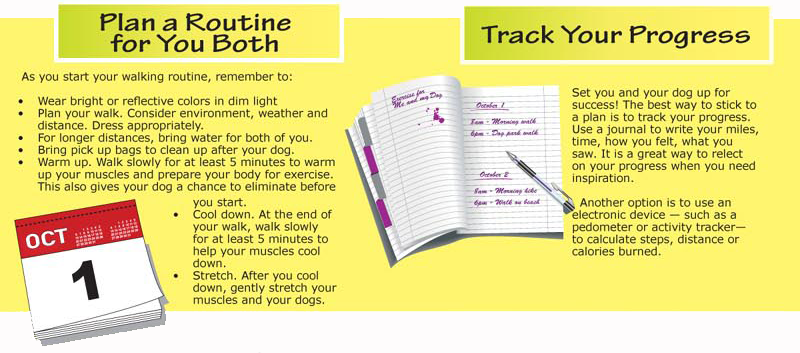
Track Your Progress
Set you and your dog up for success! The best way to stick to a plan is to track your progress. Use a journal to write your miles, time, how you felt, what you saw. It is a great way to relect on your progress when you need inspiration.
Another option is to use an device — such as a pedometer or activity tracker— to calculate steps, distance or calories burned.

Set Realistic Goals
The Department of Health and Human Services recommends at least two hours and 30 minutes a week of moderate aerobic activity or one hour and 15 minutes a week of vigorous aerobic activity — preferably spread throughout the week — and strength training exercises at least twice a week.
For dogs, recommended time will vary by breed and age. If your dog needs more activity then plan additional activates.
Generally speaking, aim for at least 30 minutes of physical activity a day for you and your dog. If you can’t set aside that much time, split it up.
If you haven’t been exercising, start slow. Build up time. If you can do more then do. The average dog and person spends more than 8 hours a day sitting/sleeping.
Increase Intensity
For extra calorie burn add hand weights or a weighted vest. For your dog, use a weighted vest that does not shift or slide and interfere with form and movement.
Where to WALK
You can walk anywhere. Trails, sidewalk, dog neighborhood, countryside, beaches, grass, sandy surfaces are better for the joints. Vary your making walking more enjoyable.
Source: DogTread.com


